Aidan McCullen Transcript
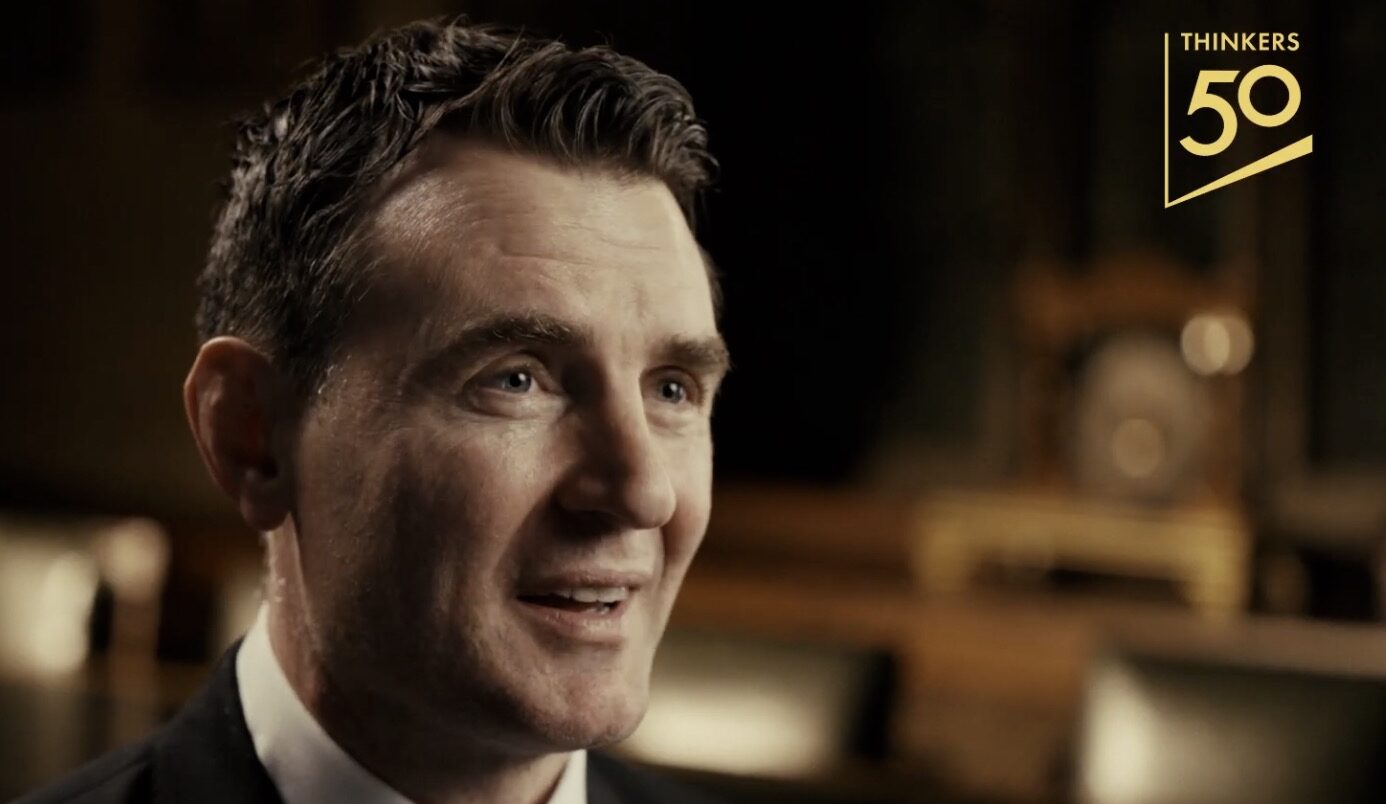
There’s only one tip for all of us that actually, you don’t care. I don’t care what you think. I care if you think it’s good, but I don’t care what you think of me for doing it. I don’t care what your judgment is of me as a speaker or putting my knowledge out there because there’s always going to be critics. And if you can’t take the fact that there’s always going to be critics, you’re never going to do anything in life. And the more impactful the work, the more critics there’s going to be.
JANE
Aidan McCullen, whom I’ve known virtually for many years, is going to be sharing his thoughts about innovation. This year, he won the Thinkers50 Innovation Award for his contribution to global innovation practice. It was in recognition for his creation of The Innovation Show, a long-standing video podcast. He also wrote the book, Undisruptables: A Mindset of Permanent Reinvention. The Innovation Show is the only podcast to ever win a Thinkers50 Award. Well, Aidan, it’s a real pleasure and privilege to have this time to talk with you. And first of all, I want to congratulate you on winning the Thinkers50 Innovation Award. That is amazing.
AIDAN
Yeah, it was a surprise for me, Jane. So, it was great. Great to be with you, by the way. And remember where we met, it was a privilege for me to have you on my podcast.
Yeah. First of all, you are the only podcast that has ever won one of the Thinkers50 events. And for me, that’s a real innovation. That’s what you’re talking about is innovation. Having a podcast as your… I know it’s not the only thing. You’ve written a book and you do other things too, but still, your podcast, I think, it’s what’s upfront for most people. And that already is a big step into the future.
AIDAN
Yeah. And you have to hand it to the Thinkers50 team as well for thinking that way that actually, the dissemination of information, no matter how it’s done, should be awarded. So, I recognize that in them as well, that they’re seeing this as a new medium. And I think it’s, as I said in my acceptance speech, which I hadn’t prepared for, but I did say, I felt like breaking the award into pieces and sending pieces to everybody who’d been on the show because I really… And I genuinely feel this way. I have a big bookshelf behind me, and it’s my intention to get through that bookshelf before I kick the bucket and before I go to the big bookshelf in the sky. But I really do feel a debt of gratitude for everybody who’s been on the show and contributed their time because that’s why I got the award.
JANE
I know exactly what you mean.
AIDAN
Yeah, exactly. Well, keep going the way you’re going. That’s the thing is to keep showing up. I think most podcasts fizzle away around episode 13, and the discipline of just showing up is half the battle.
JANE
I wanted to go back to you, and innovation for you is obviously very important. How did you come up with that name or the idea?
AIDAN
For the show?
JANE
For the show.
So, I have to go back to what was a moment of frustration, Jane. I don’t know if this has ever happened to you, but I worked with a national broadcaster, and I was head of innovation. And I pretty soon discovered that there was no innovation happening here. The strategy for innovation was to have a head of innovation sit at their desk and have a head of innovation. And my boss was actually the biggest blocker, and I was so angry at myself for not seeing it coming. And they used to send me on these wild goose chases to do these tasks. And they were just almost like you would see a road worker digging a hole and filling it in again. And I became wise to this. And it was just crazy because it was taxpayer money. And I was just so frustrated because I’d come from a 10-year career in a very entrepreneurial business where we did work. We worked really hard. We shipped loads of ideas and loads of products, and this was just the exact opposite.
And they asked me in one of the meetings, “Hey, Aidan, why don’t you come up with an idea for content that we’re not doing yet?” And I straight away, I didn’t have to think about it. I was going, “Well, there’s no content that appeals to a global audience. This is a very local audience we appeal to. What about this idea of interviewing people on business, new business models, strategy, innovation change?” And they were going, “Yeah, we tried that before.” And I was like, “Okay, well, maybe the world’s moved on a little bit.”
And I went down to the radio department, and I said it to those guys and the guy goes, “Brilliant idea. We need more talk content.” And he goes, “What’s your budget and who’s your presenter?” And I said, “No budget, no presenter.” And he goes, “I tell you what…” He liked me and he said, “I’ll give you a producer. This guy’s name is Alan Swan. I’ll give you Alan for three weeks and he’ll help you set up the show and after that, you’re on your own.” And between me and him, we’re talking about it. I thought about the Curiosity Show, and he’s like going, “No, no, no. You want a name that does what it says on the tin. It’s The Innovation Show.” So, I have to hand it to Alan Swan. It wasn’t me.
JANE
Well, I think that’s a really good name. In fact, I’m going to be asking you some questions about your view of innovation. The first thing I wanted to refer to is when my book came out, The Gig Mindset Advantage, and I just wanted to read a paragraph that you wrote on your website about it. And then, I want to move to Undisruptables because they are so close to each other. In the intro, you said to me, “The gig mindset, a freelancer style knack for improvisation, adaptability, and innovation that offers a crucial key to the future found at all levels of the workforce, but often stifled by managers, gig mindsetters are disruptors who upend business as usual and bridge gaps while achieving surprising outcomes and charting new directions.”
I was really struck. You used the word disruptor. Obviously, that struck me because you wrote the Undisruptable, and this is you now. You say, “It’s a mindset of a permanent reinvention for individuals.” And I wanted to ask you, what inspired that book? What inspired the idea of Undisruptable?
Well, I truly believe this and probably why I was attracted to your work as well. I could see myself in that work. In my opening story there about how the show was born, I’m a gig mindsetter. I know what it’s like to feel restricted in an organization by the status quo, by inertia, by people who don’t want to be shown up perhaps. And I think that was a big problem. My experience was people thought you were going too fast, but not that you were going too fast for products, for producing things or coming out with ideas or productivity, it was too fast compared to them, and they didn’t like that. So, I think these traits of being a gig mindset have always been in me. And where I wrote the book from this idea, I was going to call the book just Permanent Reinvention. And this idea of reinvention versus innovation, which we’ll probably talk about later, the difference is innovation in a way, can sometimes be easier.
So, if you’re coming up with a new idea and financing that new idea with no legacy, it’s easier than if it’s reinvention. And reinvention for me is where you have something existing and you almost need to break it apart and get rid of parts of it, get new parts of it together in order to reassemble it or recombine it to build it anew. And that’s very difficult because it means letting go of the old. And on a personal level, a lot of that means your personal identity. And in a job perhaps you know that job, you’ve outgrown that job, you have golden handcuffs maybe, you’re paying your mortgage through that job, but you’re miserable, you’re not shipping any ideas, and an organization doesn’t care versus having to give that up means letting go of that identity that’s tied to that job and going into the unknown and the danger of that.
So, that’s where this idea of being undisruptable is that you have to do that in this day and age, I think. And what I liked about your work was that I think that that is the safest way. I think in the old days, this idea of the four and 40, go to college for four years, working in an organization for 40 is well dead. Most people will work at least in four organizations, but a gig mindsetter will work for four organizations at the same time. And I think that’s safer. And that’s where I’m coming from here with this work is you cannot rely on an organization to look after you anymore. There’s very few that have those type of ethical standards that they’ll look after their people. And could you blame them? They’re under so much pressure themselves. So, take matters into your own hands if you can and become undisruptable and become a gig mindsetter.
Yeah. The two ideas just blend together so well. And that leads to my next question. I wrote an article over several months because it took me a while to do the research I needed. It was about gig mindsetters and AI inside organizations. And so, I’m very interested in AI, of course, as you and I both would be. That’s something that we need to know about. And so, I did a lot of research and I ended up with the impression, the strong feeling that gig mindsetters inside organizations are essential for successful AI projects. And I wrote the article called Unrecognized, but Indispensable, People With an Entrepreneurial Gig Mindset are Needed for Successful AI-based Projects. And the subtitle of my article was AI is a Race Between Mindsets, and the advantage will go to those who can challenge, take risks and improvise. And I think we could just replace the word gig mindsetters with undisruptables, couldn’t we?
AIDAN
Easily, easily. They are similar characters. And I think I’ve heard the terms catalysts, change-maker. They’re the same people to me. And I think for your show, and likewise for my own podcast, they’re the people who listen to the show. And we are trying to help those people navigate the world as it is today, including things like AI. But you know what happens often with AI is the organization will go to the consultants, and the consultants have no essence of what opportunities lie within the edges of the organization, deepen the bowels where the ideas come from.
And I think that’s a huge thing that oftentimes, knowledge, there’s an asymmetry between knowledge and power or status inside an organization that the people with the most valuable information or knowledge are at the edges, and they have no way to share it up to the top of the organization because they’re the people who will know immediate applications for AI versus the organization might just use it for productivity or economy to drive down economies inside an organization. And I think that’s where that article… And I’m a subscriber to your Substack. I saw it. I think that’s where this is coming from.
In that article, I mentioned that it was a division of MIT research and Wharton School also had done study over two years about AI in both cases. And they highlighted in their results, the fact that what was missing was people. The idea was that AI is advancing, but it’s going to be blocked, cannot do what it could do without people being different, without people changing things. And that really struck me. I don’t think many people think about that.
AIDAN
Yeah. And I do, like you, I use AI and a lot of people ask me, do I use it to write? Because I write a weekly article and it’s quite in-depth. I would never, ever, ever use it to come up with an idea for me, like a metaphor. And even a lot of people would throw a PDF into it and go, “Summarize this for me.” I find this almost insulting because I don’t know if… Has this ever happened with your show where somebody will send you a book and they’ll go, “I’d love you to cover my book.” And they’ll send a list of suggested questions. So, their list of suggestion questions is, this is what I think most people will ask me. And I find that insulting because I’m going, “I have such a different lens of understanding, knowledge,” and seeing it literally because we talked about this before we came on air.
As you do more and more shows, your knowledge compounds, and it’s like literally lens upon lens, upon lens, and what you see is totally different than somebody else. And that’s a brilliant thing. And I think we both share a love of neurodiversity. That’s what neurodiversity really is for me is people seeing it differently, and celebrating that, and finding that neurodiversity, and bringing it to life inside an organization because that’s where the gold is. And I think that’s the thing with AI is that it will pick out what is relevant to it versus I go through it, and I would pick out something totally different. So, why would I ever rely on it? And I think that it’s that… Sometimes it will pick out stuff I would not think of or surface some type of idea, or law, or historical story that I didn’t know about.
And I think it’s that idea of the centaur, about the machine and the human working together to create this new being. There’s a beautiful, beautiful story. I’ll send it to you afterwards, Jane. There’s an artist I listen to called Olafur Arnalds. He’s an Icelandic pianist, and I saw him play here at The National Concert Hall in Dublin. It was stunning, absolutely stunning. What he does is he has what he calls these player pianos. It must have caused him a fortune to travel around the world. He took an old piece of technology, which was called a Moog Piano Bar. So, people who know keyboards will know Moog, M-O-O-G. And this Moog piano bar was created to turn a beautiful grand piano into like a keyboard so you could make crazy sounds and play it through the Moog piano bar.
So, what he did was he got his friend to create an algorithm. So, I saw this live. He plays the piano, and then, he programmed two other pianos. I don’t know if you’ve ever seen this like in the old cowboy movies, the old Western movies that the piano would start playing by itself. You know that idea?
JANE
Yeah.
AIDAN
So, he programmed this to when he would play a key, that the pianos would play something that he would not think of playing. So, they would both play. So, the concept here was as a trained pianist, classical pianist, if he pressed an F… I’m making this up because I don’t understand music, but D major or D minor, he said, the next natural key for me would be F major or F minor. That’s the way you’re trained to think that this goes nicely with this. But he said what the pianos do because they’re programmed to do something totally different because they’re a machine, they will play a totally different sequence, and then, that will make him think differently. So, he’ll play the next key differently. And he said it’s that combination of machine and human working together that just creates a totally new sequence of music. And it’s totally brought him to life. He doesn’t get bored with his music anymore because it’s more than collaborating with another human. It’s collaborating with another entity to create something totally unique. And that for me, is the value of AI.
JANE
That is very interesting. I will certainly look him up. Very interesting.
AIDAN
Yeah. You’ll love his music as well. It’s beautiful.
JANE
Great.
AIDAN
It can be listened to it in France, chilling out, munching on a baguette.
JANE
Sipping a glass of red wine.
AIDAN
Or a croissant.
Yes. Speaking of innovation and inspiration, I’m curious to know, do you like science fiction?
AIDAN
Absolutely love science fiction. I actually write science fiction shorts.
JANE
Oh, you do?
AIDAN
It’s a hobby of mine. Yeah.
JANE
Oh, I didn’t know that. A science fiction writer, Chen Qiufan , was my first podcast guest. It’s thanks to him that I named my podcast Imaginize World. It’s because he said, I’m just going to read a quote to you, “By imagining the future through science fiction, we can even step in, make change and actively play a role in shaping our reality. In other words, with every future we wish to create, we must first learn to imaginize it.” And that’s part of the whole goal of my podcast is to think about how you can shape the world before the world shapes us.
AIDAN
Love it.
JANE
I thought you would like that.
Yeah, I love it. There’s a guy I used to really follow. He passed away recently. He was due on my show, a guy called Bob Proctor. I don’t know if you ever remember Bob Proctor.
JANE
The name is familiar, but I-
AIDAN
Yeah, he was very much a, what would I call him? He was touching on spiritual enlightenment, very much about things like the law of attraction, the law of vibration, but he had a beautiful line. He said, “If you can hold it in your head, you can hold it in your hand.” And for me, the things I’ve achieved in my life, I’ve been very lucky to have, I think, certainly several lives within a life so far because of the desire to reinvent regularly, be a gig mindsetter, because it brings it to amazing places. But I do really believe you got to see it in your head.
And even to my children, my lessons to them are like, imagine it very, very strongly every night, what you want to achieve, but then, you got to do the work because it’s not magic where you imagine it, and it will suddenly happen to you, but I do… Things that have happened for me. An example is I played for Stade Toulousain. I wrote that down when I was 20 that I wanted to play for that club, and I kind of forgot about it. And I did think about it several times, but I did the work then, and years later, it manifested.
And I really do believe that that happens. But back to your point about sci-fi, I really think that you can shape where things go. Even think about how Steven Spielberg would bring on set designers. He’d bring on futurists and sci-fi writers to shape things, to go, what would be around at this time? There’s a movie… Oh, Sandra Bullock is in the movie. It’s a futurist movie. I can see it in my head, but he did it for that. And so much of that movie came to be true. There was so much of that movie that actually they had got right.
One of them, actually, this is where it came from, Jane. You’ll love this. They got the first people ever to have online pizza delivery. They saw it in this movie with Sandra Bullock. It was a futurist movie, and they went, “That will be possible one day.” And it was just around the time Steve Jobs was with NeXT Computer, his interim time between Apple the first time and the second time. He developed this thing with NeXT Computer, with a team, and they were the first to develop a simple way of developing websites. They call it web object. And this guy saw this thing, I can’t remember, it was like Pizza Express or some type of pizza place. They developed the first pizza delivery thing based on what they saw in the movie.
Now, I think in the movie, it was being delivered by drone, but their whole idea was actually just online delivery where you could order online. I know that’s what people do now regularly, but it did not exist back then, but they saw it in the movie, and then, they brought it to life. And for me, that’s what sci-fi can do, including the dystopian side of things and where you see… I’m a fan of the Charlie Brooker show on Netflix, Black Mirror, and the whole idea of Black Mirror, it’s this idea of the phone, the black screen of a phone being a negative mirror on society. So, this is where sci-fi could take you, though it shouldn’t, hopefully. So, I’m a huge believer in it, and I think it’s like scenario planning.
And it can be used for scenario planning as well, where you can actually see this is where it could go. We need to be careful of this. Every movie, 1984, Minority Report. Those movies, I think Minority Report is Philip K. Dick, one of his… He’s a sci-fi writer. And so much of that was true. This idea of pre-crime and using AI to see what people are doing, track them, track down immigrants, all this kind of stuff. We know it’s there.
JANE
Yeah. Aidan, I also had a quote that I like a lot from Asimov. I won’t read the whole thing to you, but he talks about change, and it’s continuing change. It’s inevitable. We know that. We see it even more and more. And his final sentence is, “This means that our statesmen, our businessmen, our every man must take on a science-fictional way of thinking.” I love that.
AIDAN
Beautiful.
JANE
Some people think science fiction is just some sort of rockets in the sky, et cetera, but the whole science-fictional way of thinking of what could be and so on. I won’t go into too much detail because people see it differently, but I think it can change the way you see your own life.
And to that point, I love, by the way, Asimov. There’s loads of interviews with him online on YouTube. They’re fascinating to revisit. That’s how much of a nerd I am, Jane. I’ll look at these old interviews, but I find it fascinating to see how ahead of the curve they were. But to your point, and I think the whole idea of imaginize, imagination is… So, first, you have curiosity, but curiosity in a way, is very, very linked to imagination that it’s one of the biggest things missing in business, I think, where if a business can’t imagine possibilities for new products or services, new ways of doing things, all they’re doing is just exploiting and optimizing somebody else’s imagination. Something someone else imagined once for a period in time that may have now surpassed, and you’re going, “Well, what are you going to do for the future?”
So, this idea of business imagination is so, so important. And I think there’s an Einstein quote about it that it’s imagination is even more important than innovation. It’s something like that. I’m paraphrasing, but you can see that that’s what sci-fi for me is. That’s what ideation is for me. It’s people creating the right conditions for people to imagine. And then, whether you do something with it or not is up to you, but having that skill inside an organization is key. And I think that’s the red thread between an undisruptable, or a gig mindsetter, or a change-maker, or a catalyst, or a head of innovation that there’s these people who have this running through their blood and running through their veins, this desire to create something that’s just bubbling away in their imagination.
That brings me to another writer that I wanted to talk with you about. And you interviewed him. That’s David Weinberger. You interviewed him, what, how many years ago, five years ago, something like that?
AIDAN
Actually, I started doing video during COVID, so I think it was around the time of COVID when we were in lockdown.
JANE
He is an amazing person in the-
AIDAN
Great guy.
JANE
… different things he’s done. He’s been one of the co-authors of The Cluetrain Manifesto. That was like a revolution when it came out. I don’t think most people realized what it was really. It was a real manifesto in the true sense of that.
AIDAN
And there’s a great video online again of that with him and the co-authors. There’s not much coverage of it. It was pre-YouTube and pre-podcast. So, it is on my list there to have him back because I covered Everyday Chaos, which was more his book on complexity theory and the butterfly effect and stuff like that.
Yeah. I talked with him about what he calls the strategy of strategies is unanticipation. And the thing I think is so strong about that word is that he says that we need to do things and share what we do without having any idea, any anticipation of what other people may do with it. Yeah. He says, “You’ve got to make what you’ve done, what you’ve learned as widely available to people without knowing, without being able to predict, anticipate what they’re going to do with it.” And that’s pretty powerful. I think a lot of people keep knowledge to themselves, keep their experiences to themselves because they don’t know how it might impact others, whether they would lose credit for it, maybe it would do damage to something, to their reputation. I don’t know what the different reasons would be, but unanticipation for him is what he calls the strategy of strategies.
AIDAN
I love it.
JANE
So, I was going to ask you what you thought about that. Is it risky? Is it full of opportunities? How do you see it?
Well, I’m probably like you. As a regular writer and sharing things… Earlier on in my career, so my first job after professional rugby was, I became essentially a head of digital. So, I worked for a media company. So, I was actually teaching people on social media, digital advertising revenue, building apps, building websites. So, people writing content for those products was essential, but a lot of people couldn’t see the point. And back to my point about doing the show, when I started the show when I was in that national broadcaster, I felt that I had loads of knowledge from the show, from speaking to these people, but also, I was reading to prepare to speak to them. You know what that’s like. So, you do your work. And when you have an input, I feel what happens is it marinates and it mixes what your own thinking, your own experiences, changes how you see the world. Therefore, that becomes new and knowledge as well for you.
And for me, the reason I write is to make sense of what I’ve learned and put it out there. If it connects with people, great because it’s… I love, and I’m sure you’ve had this, when people write in and go, “I loved your article. Really made sense to me. It spoke to me. It was like you were talking to me.” Or, “The show really helped me. I feel like I’m not alone out there.” So, I really think that’s important. I have a quote, just my guiding motto for the show. It’s a poet called Edith Wharton, and she said, “There’s two ways to spread the light. One is to be the candle, and one is to be the mirror.” And I feel like the show for me is mirror work where I mirror the work of others. I reflect it out into the world. And then, the candle work is my own original writing.
And a lot of that original writing, the candle work, it includes mirror work because sometimes you think it’s your idea and it’s something you’ve absorbed or you’ve made yours. But mostly what happens is you’ve made sense of it, I think. And it’s why I do a lot of keynotes and workshops, and people are going, “Oh my God, you have no notes,” or, “Your recall is amazing.” And I’ll go, “Well, that’s because I’ve totally internalized it because I’ve written about it for years.” And that’s where I was saying at the top of the show, it compounds this knowledge, the knowledge, books, the writing, the editing the podcast, the sharing excerpts, the sharing pieces on LinkedIn, and it just rolls off your tongue, and it becomes how you think. And because it becomes how you think, then you see it more and more. So, it becomes your reality. So, for me, unanticipation, putting it out there, why would you not do that? And feeling there is some type of IP about it, I get that, but information is everywhere. Sense-making isn’t.
When I was going around and talking about my book at different conferences, mainly in Europe, I had two incidents I wanted to mention to you that go along with what you’re saying. One guy came up to me and said, “You are the first person to understand me.” And this guy was, I don’t know what his age was, maybe 50, 60. I don’t know, something like that. He was a mature person, had been working at his job for a long time. “No one has ever understood me until you talked today in your keynote. That is exactly what I am.” Another guy came up to me and said, “I bought your book, and I read it,” and he said, “I want to give you something.” And he pulled out four sheets of paper. Handwritten, four sheets of paper. He said, “I want to share with you the letter that I wrote to my HR, head of HR after reading your book.” And it had changed the way he saw himself, his company, his organization, the HR department, and he wanted to share it with me. For me, that’s unanticipation. I had no idea.
AIDAN
Isn’t it beautiful?
JANE
Yeah, I hope people would enjoy it and understand it and get the point and all that, but I could never have anticipated that some people would do things to that extent.
AIDAN
And I wanted to add one thing. Firstly, the beautiful serendipity of… So, you’re forcing serendipity, because if you sit there and do nothing, sit on your hands, nothing happens. Your book is why you’re here. Your book has redirected and re-scripted your life in ways you could not imagine, because I think that’s why putting out what you know or your opinion and doing it for… I think this is a really important thing. The fuel of it is ultimately service. So, I’m doing it to try and make a positive change. And I think I do believe that that boomerangs back in ways that you just cannot ever know.
And I think the biggest blocker you mentioned about people maybe not wanting to share their content or their ideas. I think there’s something else at the heart of it. And it’s people don’t want to be judged or this whole idea of they, what will they think? I think that’s the biggest… When I teach students… I’m a lecturer here in Trinity College in Dublin as well. And the students all are kind of going, “Oh, will you give us some tips on public speaking or writing?” And I go, “There’s only one tip for all of us. That actually, you don’t care. I don’t care what you think. And I don’t mean that in a… I care if you think it’s good, but I don’t care what you think of me for doing it. I don’t care what your judgment is of me as a speaker or putting my knowledge out there,” because there’s always going to be critics.
And if you can’t take the fact that there’s always going to critics, you’re never going to do anything in life. And the more impactful the work, the more critics there’s going to be because you’re making a bigger splash. And I do think that that’s why people don’t do things. I think people doubt themselves and go, “What do I have to say?” And there is a lot in that because if you’re not constantly reading things and you don’t have a unique way of seeing the world… And ultimately, I mentioned that word, your fuel. What are you fueled by? If I’m fueled by wanting to share knowledge that I think is valuable versus, oh, I want to create a podcast or write a blog so my people discover my brand, they’ll see through that because I do think there’s a lot of people who do that, and they do it for SEO or whatever purposes.
And people smell that a mile away, and they’re never going to do the proper work. They’re never going to be reading the books like we do and going deep and making the sacrifice and stressing over, did I do a good job of that show? All this stuff. Because they’re doing it for the wrong reasons. And I think it’s back to your point about AI and human, the human’s the missing part. If it’s the human writing the stuff or creating the stuff and the human… The missing part there is the authenticity and ultimately the fuel of why they’re doing it. And if it’s out of service or out of sense making, I think that’s the difference, and that’s what people smell a mile away.
That flows quite naturally into what I wanted to talk to you about regarding Sugata Mitra. Have you met Sugata Mitra?
AIDAN
No.
JANE
He would be an interesting guest for you, but I don’t know if he’s doing things in public anymore. I’m not sure. He did the famous hole in the wall experiment in a village in India where he made a hole in the wall and put a computer in the hole. This is way, way, way back. I forget, decades ago. And it was tied down, but it was open. And the Indian children in the village who didn’t speak any English, I forget what village it was, but the kids did not speak English. They were intrigued by this thing in the hole. And they came and played with it and discovered all these things and taught themselves… You know that now? You’re nodding your head. Okay. Yeah.
AIDAN
Yeah. Did you write about it?
JANE
I did. I wrote about it. Yeah.
AIDAN
That’s where I heard it.
JANE
Well, it’s such an incredible story for me.
AIDAN
And they didn’t have any teaching. They weren’t taught how to.
JANE
No, that’s right. What is really interesting is he gave a TED Talk. I would say a real TED Talk, not an ex-TED talk, although they’re good too. They’re fine. But he did a TED Talk and in 2013, he got the million dollar prize for a wish that you have that you want to accomplish, that you want to talk about. And he talked about this idea of what he called self-organized learning environments, SOLE, S-O-L-E. And it became a really big deal. A whole movement now today called Start S-O-L-E or StartSOLE in many different countries in the world. The idea is you set up a situation, and the kids do their own learning. They ask questions, they look for answers, and so on and so on. And he does what he calls inquiry-based learning. And that ticked in my mind when you were just talking about motivation for doing things.
And these kids were learning… They decided they wanted to figure something out, and so they did it on their own as a group. And it’s a very powerful idea. And I think that today, if schools encourage their students to do that, throughout not just kids, but throughout the scholastic career, to define something you want to learn about, and then, figure out how to do it with your classmates, it would make such a difference compared to… I know when I went to school, this was a long time ago. We just had books and we memorized things basically.
It hasn’t changed much, Jane.
JANE
No?
AIDAN
Yeah. My son’s the same at the moment, but there’s a really interesting guy you might love to talk to. His name’s Manu Kapur, K-A-P-U-R. He’s based in Singapore. He has brought into the Singapore curriculum, a brand new way of learning. It’s called productive failure. And like that, the whole concept is, say you wanted to learn something new, they test you first before you even try how to do it. So, think about how it’s usually done. It’s like teach you how to do multiplication. The teacher will go, “This is how you do this exercise on the blackboard. Now, over to you.” His whole thing is get them to try it. And when you get them to try it, it creates this gap in the brain, and the brain actually wants to fill that gap. So, it’s almost like forcing a bit of curiosity. And then, when you get taught how to do it… So, you have to try and go through the struggle, and it’s in the struggle that the learning happens.
And if that struggle doesn’t happen, the learning doesn’t happen. And this is what… If you think about resilience and the lack of resilience today, it’s because things are maybe too easy for people, making life easy for people. And then, when life gets tough, they can’t handle life. And I’m not taking… I know people can go through great tragedies, et cetera. But I do believe that everything that happens to us, and this is the source of the research I’m doing for my new book, those things build some type of muscle that is useful in ways that we don’t know in the future. They’re building some skill that we can reuse again. And had we not encountered that difficulty, we’d not build that skill. And I think that’s probably what was happening with those kids.
Manu Kapur’s point is that they had nobody telling them how to do it. And he cites all these studies where kids are playing with toys, and they’re doing different type of problems. And when they’re given the opportunity first to explore it without being told how to do it, they do so, so much better. I think often, Jane, about Lego, and Lego today, the instructions are so tight, number one, two, three, four, five, versus back when I was a kid, you just had a box of Lego, and you’d build… I usually would just build houses all the time, but you’d build whatever was in your imagination back to the whole full circle about the importance of imaginize.
Yes. I have a few questions I’d like to ask you about how you view the future. And I’ll start with one. I’d like to know, do you think there’s a common misconception that people have about the future?
AIDAN
I think people always believe, particularly as they get older, that they go, “Oh, I’d hate to be a kid at this time.” Or, “I’d hate to be growing up in this world. It’s so difficult, isn’t it?” And I think they forget beginner’s mind, that old Buddhist philosophy of what it’s like to be young in that moment. And that yes, kids these days have different struggles and different challenges, but so did we. And by, I mean we, everybody else did too. And everybody had their challenges. Businesses had their challenges. They were just different. There was wars, there was battles, there was recessions, there was crises, and we are a remarkably resilient race or beings, creatures, and we’re able to get through it. And I think people forget that. And I’m an optimist in that sense that if your head space and your mindset’s in the right place, you can get through this.
Interesting. If there were one technology you could invent, I’m not sure if technology is really your thing, but if you could invent a technology, what would it be?
AIDAN
I would love to have… And I think they already exist, but they’re not very proficient yet. One of the tasks I get given by my wife every week is to clean the bathrooms. And we have a robot. We have an iRobot, that Hoovers the house, but I’d love a machine that would do the bathrooms for me, especially the toilet.
JANE
Really? I think a lot of people would like that. I asked that same question to Sugata Mitra. He had a more creative answer than yours.
AIDAN
Well, that’s because his wife doesn’t make him clean the bathroom.
JANE
Yeah. He had this idea of a machine that would let you dial forward in increments and see what was coming in the world or dial back and see what had happened at certain times. And I wrote a little article about that that I put on my Substack. I think he called it a chronoscope or something like that. And I found that idea really interesting because it’s often said that if you don’t understand the past, you cannot imagine the future. And so, I think the idea of being able to see the past… Well, see the past, there are ways we can look at the past in a way by reading and talking to people who are older than us. But in terms of seeing the future, again, we can imagine it in certain ways. But I think the link between the past and the future is something that we forget.
AIDAN
There’s a quote I live by with my show. Before we came on air, you were commenting on the kind of guests that I’ve had. And I go back, I go as far back as I can with knowledge for that exact reason. There’s a quote by Twain, “History doesn’t repeat, but it often rhymes.” And when you read enough, because I’ll often get criticized, not criticized. People will comment on the fact that, “Oh, do you not get bored reading about innovation all the time?” And well, you would if it’s the same type of book all the time. I never go for the same type of book all the time. But what you notice is there’s essentially templates in there.
Like I did a deep dive on Nokia at the moment, like really deep dive into Nokia. And people’s story of Nokia is, oh, Nokia didn’t see the future and they failed and they missed the smartphone revolution. And it’s not true because when you read about it and you see what was… They knew about it, they saw it coming. I’m interviewing the guy who actually… And I have his presentation. He showed the presentation of what the iPhone would look like to the Nokia team, but you see what was challenging them, it was stuff like not being able to share the truth. It was fear. It was an over-investment in the past and all this kind of stuff.
And when you see those, you see them as every company is susceptible to that today. And it’s just very, very hard to read the label when you’re inside the jar. When it’s your turn, and you’re the one who’s the star of the show, it’s very hard, especially if you’re invested in it and you have sunk cost fallacies going on, you have status quo, bias, all these biases that are around every human, in every human, block you when it’s your turn. And I think it’s easy to point to somebody else and go, “I can’t believe they did that. What an idiot.” And by reading history and reading case studies, you can actually at least inform yourself to go, “Wait a second, is this me doing this this time?” And have then the cahones to go and do something about it.
JANE
I worked with Nokia back then.
AIDAN
Wow.
JANE
Yeah, it was a very interesting job. I was there in Finland maybe two or three times running workshops.
AIDAN
Wow.
JANE
And it was when they were at their height and the building was-
AIDAN
The most arrogant, by all accounts.
JANE
Yeah, exactly. Oh, exactly. Yeah. And then, I-
AIDAN
And not many women, I heard as well, very male-dominated.
JANE
At the high levels, yes. Yeah. And I was working at a lower level, and there were women, and they actually came to my office in France.
AIDAN
Wow.
JANE
I think they wanted a trip to France, but it was very interesting working with them, and then, afterwards, seeing what happened. So, I’m looking forward very much to the results of your session with this guy. I think that’s very interesting.
AIDAN
Yeah. I’ve just released episode three of it, and it’s about the reinvention. So, probably know they’re back as a networks company, and they’re back thriving again. Again, a lot of people, because they don’t read this stuff and they just move on, is they think Nokia’s bankrupt or it’s gone. And I go, “No, no.” And it’s really interesting how that surfaced, Jane. They were doing scenario planning, and they never did proper scenario planning at the high levels before because they were so defensive of the mobile phone business. And it was the CFO who said, “What if we buy the networks business?” Because they had this partnership with Ericsson, I think it was, and it was so unprofitable, and it looked so unattractive. They’re like, “Oh, it’s a boring business.” And they’re like, “But our identity’s about the phone.” So, they had this big…
But they went through cycles of scenario planning and cycles of not being over emotional and not having emotional reactions about it and having outside… And listening to the consultants, the outside voices versus back in, I’m sure at your time, they didn’t really challenge what they thought, and they went and they backed the networks business, and now, look at them today. They’re thriving. They’re one of the top in the world.
Yeah. Interesting. My last question for you is more pragmatic, more practical. What can an individual do to bring change? It’s not always big companies or it can be an individual person, maybe in a very limited professional situation, I don’t know, but what can a single person do in their mind or in their actions?
AIDAN
There’s a quote by Tolstoy, and it’s that everybody wants to change the world, but nobody wants to change him or herself.
JANE
Good, good quote.
AIDAN
Yeah. I love it because I think it’s easy. And again, one of these little hacks I have for life is that when you point the finger, there’s three pointing back to yourself.
JANE
How nice.
AIDAN
Oftentimes, when you’re complaining about somebody, you kind of go, “Yeah, but what am I…” Maybe somebody is rude to you or behaves in a certain way to you. What am I doing to trigger that? And equally, as a change agent or a gig mindsetter, you’re going… Sometimes if I’m seen as the change maker and I’m critical of the status quo, of course they’re going to reject me. I need to find common ground. And I think finding that common ground and working on the communication element of change and finding the overlap in the Venn diagram is essential to any kind of change. And that’s the same for relationship, just understand the other side. And really, I think on a personal level then too, for change for yourself is that golden rule I talked about earlier on, don’t care what other people think. You can’t. If you care what other people think, you’re not going to do much in life.
Are you able, Aidan, to talk about your new book?
AIDAN
Sure. Yeah. I can mention it. Yeah. I haven’t signed the contract on it yet, but it’s really just about this concept of how there’s assets in the ashes. So, when something breaks or something doesn’t go your way, and it’s not going to. The more things you do, the more things are not going to go your way. And to not see them as the crisis that they seem to be in the moment. An easy way to do this, Jane, is every single one of us, look at yourself in the mirror and go, “If that thing that happened to me that I thought was an absolute crisis at X time in my life didn’t happen to me, I wouldn’t have done Y.” Everybody has one of those.
And that’s what this book is about, tracking that as a case studies in businesses where the business thought they were out of money or they ran into some kind of cul-de-sac and all of a sudden, found a new much more profitable opportunity, just like Nokia and to just have the courage to carry yourself through those moments because it’s inevitably going to happen. And if you’re a gig mindsetter, if you’re one of Jane’s crew, remember that that will happen and that it’s just part of the process. And a simple way, Jane, I taught this to my kids. It’s in my book, Undisruptable, was when they were younger, I used to bathe them. So, in the bath, and one day, one of my kids had had a bad day, so I brought two of them. They were so sick of me giving all these little stories all the time.
So, I started to swoosh the water up and down, and it created a wave. And I was like, “Look at the bath here.” I said, “Look, it’s the same water, but some of it’s high and some of it’s low. And then, some of it’s low and some of it’s high.” I was going, “That’s what happens in life that you have highs and lows.” And I turned to them and I’m going, “Do you get what I’m saying here?” And my younger guy who was probably about three at the time, he’s staring at the water. I thought I really hit home to him and he goes, “Will you put me in there and do that?” So, months later, my other son broke his arm, and I came home, I said, “Oh, buddy, are you okay?” And he goes, “Dad,” he goes, “I was just at the bottom of a wave.”
JANE
Nice.
AIDAN
Yeah. So, it hit home. But I do think that’s life that when you’re in the trough of a wave, all you can see is the water coming for you. And so, unfortunately, for us as humans, when we’re on the crest of the wave, we don’t stop and smell the roses and appreciate it. We’re always thinking of the higher wave, the next wave, but I think that that’s so important to train yourself to realize that the low will be transient and so will the high. And when you’re on the high, expect the low, be ready for it. You know that there’s another high coming.
JANE
We could call that a next practice. You know how people always refer to case studies with best practices? And I don’t know if you’re familiar with C. K. Prahalad who brought out the term next practices?
AIDAN
I didn’t know that that’s where it came from. Love it.
JANE
Yeah. Yeah.
AIDAN
I did a long form series with Gary Hamel, his co-author.
Yeah. Yeah. Yeah. I like C. K.’s next practices very much.
AIDAN
I think one of the things I learned from your book now that comes to mind was the importance of a forgetting curve.
JANE
The forgetting curve is more important than the learning curve. Yeah. So, I think we’re going to wrap up now, Aidan. Any final thoughts that you’d like to share?
I really do want people to live their potential and not settle. And I do understand that there’s a lot of fear out there for people and that they don’t want to be exposed. We have mortgages to pay. I just think that there’s a quote by a guy, I quote him in the book. It’s Dr. Harry Thurman, I think, and he said, “Just picture this.” So, I’m going to paraphrase here. “Picture one day, you’re lying on your deathbed and all the ghosts of what you could have done in your life appear at the side of your bed, and they all point to you and go, ‘Because of you, we never came to life.'” And for me, that is just a game-changer. Don’t let that happen. You’re not going to be able to do all those things, but do some of them because life is short.
JANE
Well, that’s a great idea to end our conversation on. It’s been a lot of fun, Aidan. We’re going to have to do this again. We can’t let five years go by. So, we’ll do another one maybe in a year or two. In particular, when your book comes out, that would be wonderful.
AIDAN
With pleasure, Jane. And have you got any new books on the way?
JANE
I do not, no. I decided to work on the podcast rather than working on a book.
AIDAN
I’ll give you a few years because so much will bubble up. You’ll want to get it out there.
JANE
Well, I must admit that I have a plan using an AI tool to go through all my past work for the last, what, 20 years and bring out the themes and the ideas and see if there’s some way I can bring some sense to all of it. But if I do that, I’ll talk to you about it later.
AIDAN
With pleasure.
JANE
Okay. Well, thank you very much, Aidan, and I think we’ll call it a day then.
AIDAN
Been a pleasure, Jane. Wish you well.
JANE
Thank you. Feeling is mutual.
AIDAN
A la prochaine!
JANE
A la prochaine!
 SUBSCRIBE TO IMAGINIZE WORLD ON YOUTUBE
We talk with forward thinkers, scifi visionaries and pioneering organizations about people and society, AI and humans, the earth and survival. Read more Imaginize.World
Nothing matches your request, please try again with a different search term.
 Share
Share